|
|


Patent row brews ahead of WTO summit |
Thursday, 25 October, 2001, 16:49 GMT 17:49 UK
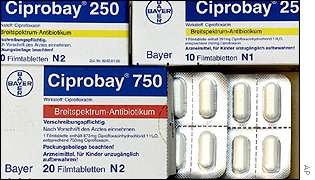
The US govt threatened to override the patent on Cipro
Pharmaceutical patent law is expected to top the agenda at the World Trade
Organisation (WTO) summit in Doha, Qatar, in two weeks' time.
Developing countries want the rules relaxed to allow them to import or manufacture cheap generic versions of patented drugs. Historically the US has been a staunch supporter of the current laws, arguing that companies need to be assured of the money from patents to plough into research. But anthrax scares in the US seem to have weakened the government's stance and earlier this week it threatened to override the patent held by German drugs company Bayer on anti-anthrax drug, Cipro, if the company didn't agree to a substantial price cut. After negotiations Bayer agreed to slash the price of Cipro to below $1 per tablet. Ambiguous rules The disputes over reproducing patented drugs on the cheap arise from ambiguous clauses in WTO rules on intellectual property. According to the WTO's Trade-Related Aspects of Intellectual Property Rights (TRIPS), member countries are required to recognise international patents on medicine. However, the rules also say that "this requirement may be waived by a member in the case of a national emergency or other circumstances of extreme urgency". However, as a WTO spokesman points out, "there are no clear boundaries defining an emergency and this has not been tested in the courts". Adrian Lovett, policy and campaign coordinator at the development charity Oxfam, told the BBC's World Business Report that the WTO needs to make clear that "the health of people in national emergencies is more important than the profits of private companies." Bimal Raizada, Senior Vice President of Indian drug company Ranbaxy, said he believed that generally pharmaceutical companies were responsive if approached by governments facing national health emergencies. Government u-turn Just last summer, the US was planning to file a complaint with the WTO against Brazil for allowing the alternative production of patented Aids-treatment drugs. In June it dropped the complaint, announcing that it preferred "to resolve trade disputes by seeking constructive solutions". US protectionism with regard to its domestic pharmaceuticals industry was also evident in a long-running dispute with South Africa.
The US government was not involved in a
failed court case brought by pharmaceutical companies against South Africa's
government, but it had been involved in negotiations prior to the case.
The dispute began over the wording of South African legislation on
producing generic copies of patented drugs in times of national emergency.
However, the court case soon became focused on South Africa's access to
cheap anti-Aids drugs for the 11% of its population who are HIV positive.
Power games
Dr Harvey Bale of the International Federation of Pharmaceutical
Manufacturers told World Business report that the real barrier to medicine is
not patent protection.
He said the blame lay with government policies that allocate inadequate
funds to healthcare.
However, Oxfam's Adrian Lovett believes that poorer countries who say they
need to get certain drugs made generically are immediately faced with the
threat of a law suit.
He said in many of these cases the pharmaceutical companies are actually
bigger than the countries as a whole.
"So it is really a power game where the pharmaceutical companies are
able to exert disproportionate influence over these countries to persuade
them not to take their case any further," he added.
|