|
|


|
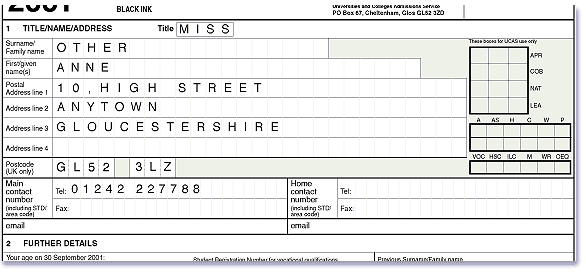
The seven-digit number in the top right-hand corner of the form is for our use only. It is not your application number. UCAS will write to you with your application number after UCAS have processed your form. UCAS use a computer to read page 1 of the form. Please use BLOCK CAPITALS on this page and try to write inside the boxes like this.
1 Title/Name/Address Give your title (for example, Mr or Ms), your surname or family name and your first or given names (the name you are known by) in the spaces provided. Your postal address is the address where UCAS and your chosen universities or colleges will write to you. Give your main contact number where UCAS will be able to contact you. Please give your email address if you have one, and a fax number if you have access to a fax machine and permission to use it. If you have an address abroad, remember to include the international dialling code in your number. Please also give your home contact number, fax and email address if they are different to your main contact details.
2 Further details Please give your date of birth, your sex, and your age on 30 September 2001. This shows universities and colleges how old you will be at the start of the next academic year. Student Registration Number for vocational qualifications or Scottish Candidate Number (SCN). If you are taking, or have taken, a BTEC diploma or certificate, or a GNVQ with Edexcel, OCR, AQA, BTEC, RSA or City and Guilds, enter your Student Registration Number. If you are taking Scottish qualifications, give your Scottish Candidate Number (SCN). Enter your number from the left, and leave any boxes you do not need blank. Ask your school or college if you do not know your number. If you have a disability, special needs (including dyslexia) or a medical condition, please select the most appropriate code from the list below and enter it in the box on the form. If you do not have a disability, special needs or a medical condition, use code 0. UCAS collect this information to help monitor progress in equal opportunities in higher education. Universities and colleges do not use this information when they decide whether to make you an offer. If you do not want to give this information now, leave the box blank. You must tell your chosen universities or colleges immediately UCAS write to you with your application number. If you will need special facilities, support or accommodation, or extra time to complete your course, please explain in section 8 on page 3 of the form. Universities and colleges welcome students with disabilities, and will try to meet your needs wherever they can. UCAS recommend that you make an informal visit to your chosen universities or colleges to discuss your needs, and to make sure you are happy with their facilities. They may ask you for more details to help them plan for you, but they will treat any information you give them as confidential. If you apply to a university or college that cannot provide the facilities you need, you can ask UCAS to change your choice. You can find out more about access and facilities for students with disabilities from university and college websites and prospectuses. You may be able to get extra financial support or help with care. To find out more, please write to Skill: National Bureau for Students with Disabilities, Chapter House, 18-20 Crucifix Lane, London SE1 3JW or phone free on 0800 328 5050 (voice) or 0800 068 2422 (minicom), or visit the Skill website at www.skill.org.uk
You should say here who will assess you for tuition fees, or how you will pay for your course. Please read the notes below. You must pay towards the tuition fees for each year of your course (different arrangements may apply in Scotland). Most students can get help towards these fees, and also a loan to help cover living costs, depending on family income. The local education authority (LEA) will assess how much you need to pay and the amount of loan you should receive, so you should give the name of your LEA (for example, Essex) under student support arrangements. You can find out more about fees and loans from the booklet 'Financial Support for Higher Education Students', published by the Department for Education and Employment (DfEE), which you can find in your careers library. You can get your own free copy by calling free on 0800 731 9133, or you can find it on the DfEE website at www.dfee.gov.uk/support/index.htm Fee code Choose one code from the list below and enter it in the box provided, to show how you expect to pay for your tuition fees. Most applicants from the UK, Channel Islands, Isle of Man and EU will be in category 02. You should use this code if you are eligible for assessment under student support arrangements, even if you think your family income will be too high for you to receive support. If all, or part, of your tuition fees will be paid by an award from another organisation (for example, a National Health Service bursary, a company sponsor or a training agency), please choose the appropriate code. If you are still applying for sponsorship, give the name of your first choice sponsor in your personal statement (section 10, page 3). You can find out more about company sponsorship from your careers adviser. You should also say on the form if you plan to defer to 2002, if your application for sponsorship this year is not successful. National Health Service bursaries (grants) are available to UK applicants only for certain health professional courses (nursing, midwifery, dental hygiene, dental therapy, occupational therapy, orthoptics, physiotherapy, radiography, chiropody, dietetics, prosthetics and orthotics, and speech and language therapy). If a university or college offers you a place on an NHS-funded course, it will send you an application pack for a bursary. You can get more information from the student support booklets previously mentioned. For nursing and midwifery, there is a careers helpline on 0171 391 6200 or 0171 391 6205. If you want to study in Europe during your course, you can find out more about SOCRATES (an inter-university scheme funded by the European Union) from your chosen university or college. You should only use code 01 if you are paying all of your tuition fees from private finance and you are not eligible for assessment under student support arrangements. A small number of
universities and colleges do not receive public funding and their students
may not get help towards tuition fees under the student support
arrangements. These institutions are clearly marked in the 'UCAS
Directory'. Please read their prospectuses and 'UCAS Directory' entries
for more information.
Date of first entry to
live in the UK
If you were born outside
the UK but now live in the UK, please give the date when you began living
here permanently.
Residential category
The level of tuition fees
you pay (home or overseas) depends on your residential category. Most
applicants from the UK, Channel Islands, Isle of Man and EU will be in
category A. If you are an international applicant, or you are not sure
which category to use, please answer the questions below to find the
category that best describes you, and put the code in the box provided.
Important words and phrases are explained at the end of the questions.
The code you choose
is provisional. The universities and colleges make the final decision on
your residential category and they have the right to change your code. UCAS
cannot tell you which category you should choose.
Questions to help you
determine your residential category
(You will find notes 1-5 at
the end of the questions.)
Area of permanent
residence
If you live in:
Country of birth
Please give the current
name of the country where you were born.
Nationality
Please give your
nationality (as written on your passport, if you have one). If you have
dual nationality, you can give both.
Previous surname or
family name
If you have changed
your name, please give your previous surname or family name. This will
help UCAS to check your educational
records.
Home address
If your postal address is
different from your home address (for example, if you are at boarding
school), please give your home address and home contact number in the
spaces provided.
3 Applications in 'UCAS Directory' order
List the courses you have
chosen in the order they appear in the 'UCAS Directory', not in your order
of preference.
Please put each choice on a
separate line. Start at the top, and do not leave gaps between choices,
even if you are only choosing two or three. If you want to apply for more
than one course at the same university or college, you must put each
course on a separate line.
You can choose up to
six courses. If you are applying for medicine, dentistry, veterinary
medicine or veterinary science, you can only choose four. If you give
more than four choices for medicine courses (codes A100, A101, A103, A104
and A106), dentistry courses (codes A200, A203, A204, A205 and A206) or
veterinary medicine or science (D100, D101), UCAS
will not process your application. UCAS
will ask you to reduce your choices in these
subjects to four but this will delay your application and you could miss
the deadline. However, you can still use your other two choices for
different subjects if you want to.
There is an early closing
date - 15 October 2000 - if you apply for medicine, dentistry, veterinary
medicine or veterinary science, and to Oxford and Cambridge Universities.
If you are applying to Oxford or Cambridge, you should only make your
entry for that university on one line.
If you are applying for medicine,
dentistry, nursing and midwifery and certain other health courses, UK
health authorities recommend you should be immunised against Hepatitis B
when you start training. Institutions may also ask you for certificates to
show that you are not infected. If you are applying for one or more of
these subjects, you should check the immunisation requirements with the
universities and colleges you have chosen.
You cannot apply to both Oxford
and Cambridge unless:
If you are applying to Art
and Design courses, see Art
and Design courses for more information.
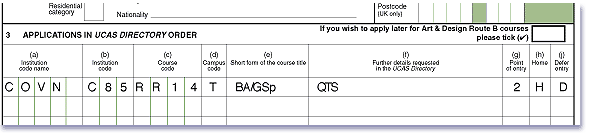
The example below shows
what a filled-in line should look like.
4 Secondary education, further education and higher education Give the names and brief addresses of the three most recent secondary schools, colleges and universities you have attended, with the most recent one first. You must give this information, even if you withdrew from your course. Use numbers for the month and year (for example, 09 94 instead of September 1994), and say if your study was part time (PT), full time (FT) or a sandwich course (SW). If you are a mature student, please give the name, address and dates of your last full-time school or college, plus any schools or colleges attended more recently.
5 National Record of
Achievement and Progress File (UK students only)
Tick the boxes if you
have a National Record of Achievement or Progress File (or both). Do not
send them to UCAS.
6 Additional information
UCAS
use this information to monitor application rates and equal opportunities.
UCAS do not give this information to
universities or colleges until after the selection process.
A Occupational
background
If you are under 21, please
give the occupation of your parent, stepparent or guardian who earns the
most. If he or she is retired or unemployed, give their most recent
occupation. If you are 21 or over, please give your own occupation.
B Ethnic origin (UK
applicants only)
Please give the code from
the table below, which most closely describes your ethnic origin. |
|||||||||||||||||||||||||||||||||||||||||||||||||||||||||||||||||||||||||||||||||||||||||||||||||||||||||||||||||||||||||||||||||||||||||||||||||||||||||||||||||||||||||||||||||||||||||||||||||||||||||||||||||||||||||||||||||||||||||||||||||||||||||||||||||||||||||||||||||||||||||||||||||||||||||||||||||||||||||||||||||||||||||||||||||||||||||||||||||||||||||||||||||||||||||||||||||||||||||||||||||||||||||||
|