|
The
Phillips Curve
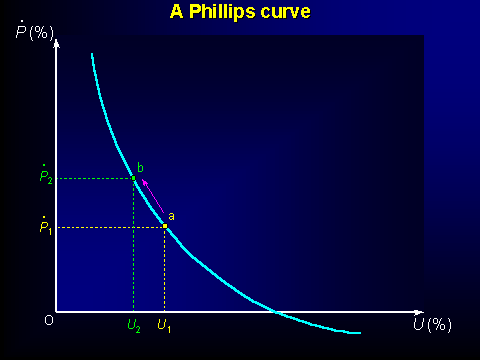
The Phillips Curve demonstrates the
trade off between unemployment and inflation. It is based upon unemployment
and wages data between 1862 and 1957.
Adaptive Expections and The Phillips Curve
Each short-run Phillips Curve (SRPC) is drawn
on the assumption of a given expected rate of inflation. If there is a
change in inflation expectations in
the economy we see a shift in the Phillips Curve.
This theory is based upon adaptive
expectations – people base their expectations of inflation on past levels
of inflation.
If we look at an imaginary economy over a
number of years it will help us understand the relationship between different
SRPCs.
Year 1 - there is no inflation of any sort
and it leads to unemployment of 8% at point a on the diagram.
Year 2 – the government expands AD in order
to reduce unemployment. Unemployment falls to 6%, moving along SRPC I to
point b where inflation is now 4% as people are basing their expectations of
inflation on year 1.
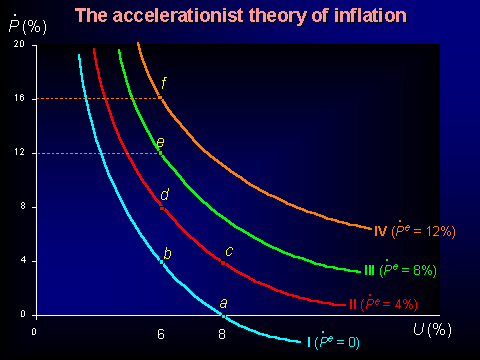
Year 3 – People now revise their
expectations to the level of year 2, 4%. The SRPC shift upwards by 4% to
II. If money AD continues to rise at the rate, the whole of the increase
will be absorbed into higher prices. Real AD will fall back to its original
level and the economy will move to c where unemployment is 8% again, but it’s
now associated with 4% inflation.
Year 4 – the government isn’t happy that
unemployment has risen to 8%, therefore it expands AD and the unemployment
level falls to 6% again, moving to d on the SRPC II. Inflation has now risen
to 8%.
Year 5 – Expected inflation is now 8% and
the SRPC shifts to III. If the government wishes to keep unemployment at 6%
it must increase AD again moving the economy to e at 12% inflation.
This adaptive expectations theory of the
Phillips curve is sometimes known as the accelerationist theory as the
government must accelerate the price level each year if it wishes to keep the
level of unemployment below the equilibrium.
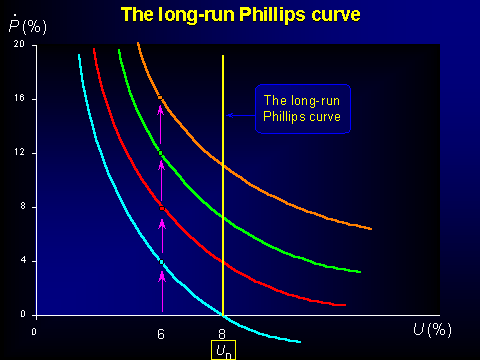
In our example unemployment of 8% will be
the natural rate of unemployment or the non-accelerating inflation rate of
unemployment (NAIRU). This means the government can only reduce unemployment
below the NAIRU in the short run. In the longrun we are able to construct a
long run Phillips curve, which is drawn vertical at the NAIRU.
The NAIRU
The Non Accelerating Inflation Rate of
Unemployment is the level of unemployment at which inflationary pressures in
the economy are stable. According to supply-side economists, unemployment
cannot be held permanently below its natural level.
Some argue if actual unemployment falls
below the NAIRU/natural rate (i.e. equilibrium unemployment) - there is
upward pressure on wage inflation that then feeds into general price
inflation.
Clearly changes in unemployment do have an
effect on the risk of inflation. Consider this comment from the Bank of
England.
"Developments in the labour market are a key
determinant of domestically generated inflation." (UK Monetary Policy
Committee minutes)
As unemployment falls towards the
NAIRU, skill shortages exert upward pressure on wages and producer prices,
until any further falls in unemployment lead to future higher inflation.
What
Determines The Nairu?
The NAIRU can and does vary between countries
and changes over time for any one particular economy.
The rate of unemployment at which inflation
starts to accelerate is determined by the efficiency of the labour market and
the relative strength of employers and employees in the wage bargaining
process
The changing nature of the wage bargaining
process
·
Strength of Trade Unions
- Unions have become much less powerful in the UK over the last twenty years.
This has tilted the balance of power towards employers and helped to keep
"inflation-busting" pay claims in check
·
Centralisation /
decentralisation of pay bargaining
There has been a switch towards local and regional pay settlements that can
take more account of local differences in labour demand and supply
·
Scale of involuntary
structural unemployment in the economy
- measures to reduce structural unemployment should help to reduce the NAIRU
if effective. This is because they increase the available labour supply in
the economy, e.g., Labour’s New Deal
Competitiveness of product markets - impact
on producers and labour
·
When product markets are
more competitive there is intensive pressure on firms to control costs.
Wage increases might only be justified by improvements in productivity
"External-shock" effects on wage bargaining
The economy can be affected by external
economic shocks that effect expected inflation.
·
The global economic crisis in
the Far East in 1998 has brought down expectations of inflation
·
The fall in international
commodity prices has had a similar effect - causing a sharp fall in inflation
in many countries across the world. Lower input costs cause an outward shift
in short run aggregate supply in the economy and should help to increase the
real volume of national output
·
The events on September 11th
caused people to feel that the global economy would move towards recession as
aggregate demand falls; this would lead to a reduction in inflation.
Most economists believe that the natural rate
of unemployment has fallen in the UK over the last decade. This means that
the economy can sustain a lower rate of unemployment without triggering off a
renewed burst of wage inflation. The evidence supports this positive view
often improving trade-off between unemployment and wage/price inflation. By
the summer of 2000, unemployment in the UK had fallen to just 3.8% of the
labour force (using the claimant count measure) whilst retail price inflation
had remained comfortably within the government's target (2.5%) and wage
inflation was under control.
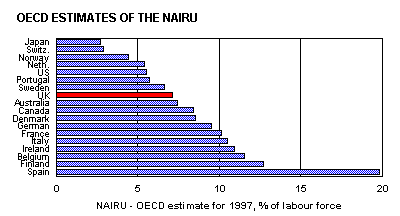
Economists at the OECD have estimated the
NAIRU for the leading industrialised countries. Their estimates for 1997 are
shown in the chart below. The UK comes out favourably in this international comparison. Our estimated
NAIRU is substantially below that of
Germany and France - although some way above that for the United States and
Japan. The Netherlands (another country to have introduced widespread labour
market reforms over the last fifteen years) is also estimated to have a lower
NAIRU than the UK.
Clockwise
Phillips Loops
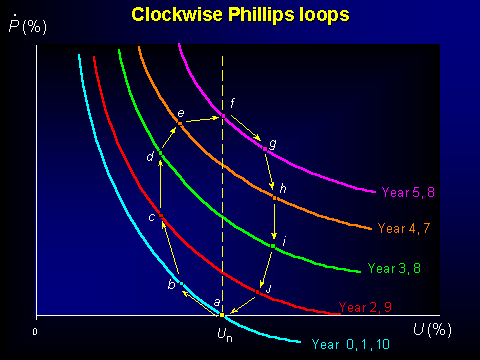
Over recent years the Phillips curve
relationship has broken down, as the UK was able to enjoy low inflation and
unemployment during the 1960s. The clockwise Phillips curve loop was
developed to explain the boom/bust years. If we consider a 10 year period
where we start at 0% inflation at the NAIRU. The government then pursues an
expansion policy in order to reduce the level of unemployment and the economy
moves through points b, c and d.
The government now starts to worry about the
level of inflation and allows unemployment to rise and the economy moves to
e. There is still some demand pull inflation as expected price level is
below the actual price level and the economy moves to f.
The government now wishes to reduce the
level of inflation so it allows unemployment to rise above the natural rate
as AD is reduced. The economy returns to a via g, h, i and j. We are able
to see stagflation (inflation and unemployment rising) from points d to f.
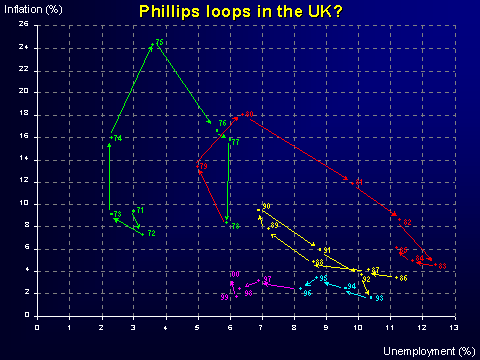
From 1971 we can see that there have in fact
been a number of Phillips loops that have occurred. The shifting loops imply
that the natural rate of unemployment changed from 1970-2000.
Monetary policy is used to control inflation
NOT unemployment. In order to reduce unemployment in the longrun it is
necessary to undertake supply side policies.
 Further
Reading Further
Reading
The Phillips
Curve by Kevin Hoover, University of California at Davis |


