|
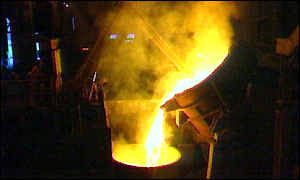
Russia has agreed
to limit its exports of steel and other metals to the United States over a
five-year period, after Washington threatened to introduce quotas and
punitive tariffs. Meeting in Paris, the two sides signed an agreement,
outlining in detail how much steel Russia is allowed to export in each year.
US Commerce Secretary William Daley said the agreement delivered "the
administration's commitment to guarantee that surging imports do not threaten
the livelihoods of communities and workers" around the United States.
During 1998 steel producers in Russia, Japan and Brazil captured a large
share of the US market. US steel producers accused their rivals of
"dumping" and called for the introduction of quotas. Many industry
analysts, though, say the success of foreign producers was triggered by the
strong dollar, which made their products very cheap. By signing the
agreement, the Russian government has avoided a potential trade war with the
United States. Russia's Trade Minister Mikhail Fradkov said the accords were
the result of a difficult compromise. He added that the deal was aimed at
lifting the threat of Russia being completely excluded from the US market,
which could have cost Russia $1.5bn in export earnings over five years.
The
deal will reduce Russian shipments for hot-rolled steel by 64% this year
compared to 1998. The quotas will gradually rise over the following four
years, climbing to a high of 725,000 metric tons in 2003. According to US
officials, this would still be well below the 1998 level of imports. In
return, US anti-dumping proceedings against Russian hot-rolled steel will be
halted. A second agreement sets quotas for 15 different types of Russian
steel exports with a total volume of 2.7 million tonnes. The deal was made
after a marathon bargaining session. Final obstacles were overcome with the
help of phone calls from Vice President Al Gore to Russian Prime Minister
Sergei Stepashin on Monday afternoon and again late Monday night.
Tuesday,
July 13, 1999 Published at 17:24 GMT 18:24 UK
|


