|
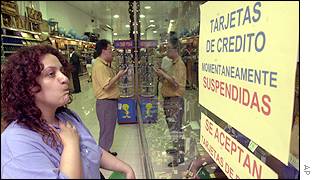
Shops
are demanding cash in case credit cards fail
Federico O'Conor has recently abandoned plans to buy an
apartment and has put his planned holiday to France on hold.
Why? Because Mr O'Conor lives in Argentina.
"I was going to take out a mortgage in December,"
Mr O'Conor, a planning chief at a local pharmaceutical company, told BBC News
Online.
"But then I decided it was not the best thing. I was
lucky - or smart," he adds, with a laugh.
Like many of his fellow Argentines, Mr O'Conor faces limits
on what he can withdraw from the bank and is concerned about his savings.
But his latest concern is the government's announcement to
devalue the peso and the impact this will have on the price of everyday
goods.
"People are very worried," he says.
A new plan?
Argentina's new president, Eduardo Duhalde, wants to devalue
the local currency by nearly a third as part of a new plan to revive the
country's economy.
The Argentine peso has been linked at one-to-one to the US
dollar since the early 1990s as part of an effort to beat hyperinflation.
In theory, the devaluation could leave Argentine companies
that have big debts in dollars, but earn their revenues locally, facing
bankruptcy.
"There will be a lot of pain," says Richard Fox, a
senior director at the ratings agency, Fitch IBCA.
Protecting consumers
Consumers, however, with dollar loans and wages in pesos,
could be off the hook.
In an apparent bid to ease the pain for the middle classes,
the government will convert any dollar loans - or mortgages - under $100,000
into pesos.
The trade-off is that the government would likely need to
bail out the banks that would lose money on the devalued loans.
Mr Duhalde's team is already considering a tax on petrol
exports to fund any compensation it will have to provide.
Mr O'Conor says the conversion of loans should protect most
people, although they may still have to contend with steep prices rises in
the shops.
"Common people won't have problems, but corporations
will," he adds.
Peril for the importers
The pharmaceutical company for which Mr O'Conor works will be
particularly affected because it depends on importing raw materials.
Once the peso is devalued by 30%, the price of any imports
will increase by the same amount.
Although food produced locally would probably be unaffected,
Argentina is a large importer of other consumer goods.
"This will really hit the middle classes and the small
businesses that import," says Sheila Page, an expert on South American
trade and finance at the Overseas Development Institute.
Winning and losing
The only winners are the country's exporters which have long
complained about being unable to compete with foreign producers because of
the currency peg.
Suddenly, with the devaluation, Argentine goods could soon be
30% cheaper abroad.
However, such is Argentina's plight, that this drop in value
would only make exporters "reasonably competitive", says Ms Page.
A drastic devaluation would be needed to make them more competitive,
she argues.
Exporters will also have large dollar debts to deal with and
could have problems accessing credit following the country's default on its
public debt.
Avoiding a devaluation?
Any alternatives to devaluing the peso are limited.
"[The politicians] have put off the decision for so
long, they have ran out of options," says Mr Fox.
Adopting the dollar is no longer an option because the
country does not have enough dollars to replace the pesos in circulation, he
adds.
An earlier plan to introduce a third currency was thrown out
with the country's previous president, Adolfo Rodriguez Saa who left office
after just one week.
"Really, I am not pleased, but [devaluation] is the only
way," says Mr O'Conor, rather grimly.
Even before the government's action there had been a de facto
devaluation, with the peso trading well below the dollar on the black market.
Saving money
The prospect of a government-sponsored devaluation had
prompted many middle class Argentines to cancel their holidays this year.
"I was expecting to go to France in March, but I don't
know what to do," says Mr O'Conor.
"The price of the trip could cost 40% more than I have
budgeted for."
Other Argentines are piling their spare cash into shares,
jewellery, new cars or even property.
"Holding gold or diamonds under the bed is not very
efficient - or liquid - but it is a store of value," says Ms Page.
A political crisis?
Many in Argentina are convinced that inept and corrupt
politicians lie at the root of their problems.
"This is mainly a political situation that has grown
into an economic situation," says Mr O'Conor.
He no longer trusts the government and is hoping for fresh
elections in six month's time.
Certainly, President Duhalde will have to do more
than convert a few consumer loans, if he wants to get the electorate back on
side.
Adapted
from bbc.co.uk: Monday, 7
January, 2002
|


